
NPLB Policy Priorities
View the shareable PDF here.
Bridging Innovation & Affordability:
NPLB Policy Priorities
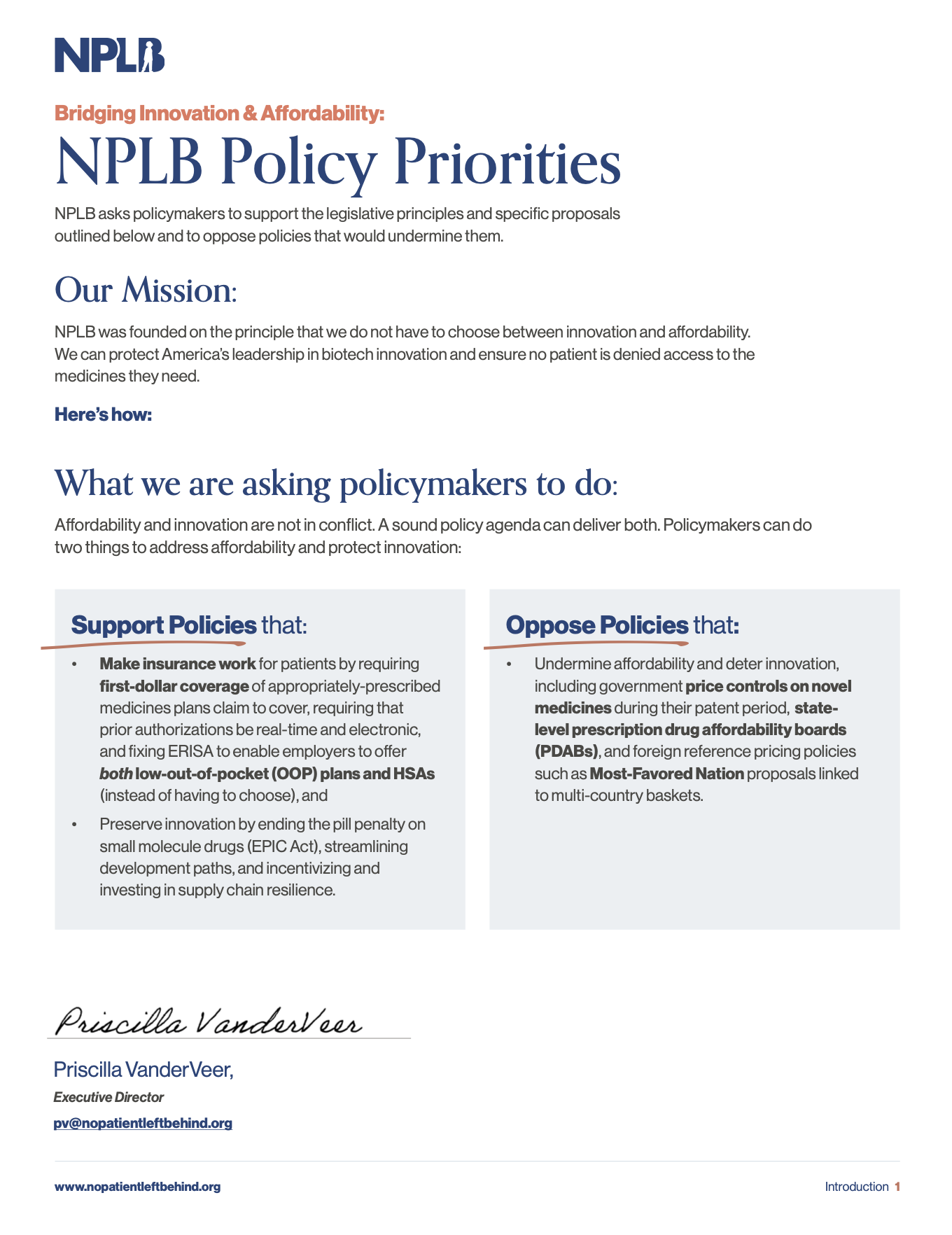
NPLB asks policymakers to support the legislative principles and specific proposals
outlined below and to oppose policies that would undermine them.
Our Mission:
NPLB was founded on the principle that we do not have to choose between innovation and affordability.
We can protect America’s leadership in biotech innovation and ensure no patient is denied access to the
medicines they need.
Here’s how:
What we are asking policymakers to do:
Affordability and innovation are not in conflict. A sound policy agenda can deliver both. Policymakers can do
two things to address affordability and protect innovation:
Priscilla VanderVeer,
Executive Director
pv@nopatientleftbehind.org
Introduction
www.nopatientleftbehind.org Introduction 2
Executive Summary
Americans are angry about drug costs, and that anger is driving policy proposals, such as price controls on novel medicines, that feel satisfying
but won’t actually help patients afford their medicines. No Patient Left Behind exists to redirect that energy toward reforms that solve affordability
while preserving innovation.
Fix insurance, and you fix affordability.
The core insight is simple: many Americans have insurance but still can’t afford their medicines. The problem is not that drug prices are too high
in the abstract but that insurance is allowed to claim it covers a medicine and then make that medicine unaffordable through deductibles and coinsurance. The need is clear: make insurance work like it should through first-dollar coverage of appropriately prescribed medicines. People who
paid their premiums shouldn’t have to pay twice.
Incentivizing innovation pays off.
Only 8% of healthcare spending goes toward novel medicines, creating incentives for investment in R&D of all the cures we are still waiting for.
As long as that 8% comes from premiums rather than out-of-pocket costs, incentivizing innovation is something all Americans can afford. Price
controls on novel medicines during their patent period are self-destructive, cutting off the pipeline patients depend on while leaving the insurance
problem untouched. And not paying for new medicines wouldn’t even save the US money since we would be stuck spending on hospitals and
doctors to manage diseases that medicines could have prevented. And unlike hospitals, whose costs only rise, medicines go generic.
NPLB’S Policy Priorities
1. #FixInsurance:
Having insurance with low out-of-pocket costs is the root of fixing affordability.
When insurance middlemen can take a generic drug that a company sells for $5 and make it cost a patient $200, it is clear that the
affordability problem is a function of insurance, not what drug companies charge.
The drug affordability crisis is a failure of insurance design, not a failure of the innovation model. Market-based pricing for a patentdefined period of exclusivity drives life-saving research that benefits all of society, yet patients are often forced to bear a disproportionate
share of that cost out of pocket. Proper insurance spreads the risk across everyone so that the healthy subsidize the sick through premiums,
rather than the other way around.
No one fakes cancer, diabetes, or asthma to get chemo, insulin, or inhalers. Let’s challenge the long-held yet unfounded assertion that
patients need financial “skin in the game” to prevent over-utilization. The real problem is under-treatment. If a patient has paid their premiums
and then can’t afford an appropriately prescribed medicine, that’s not true insurance. We need insurance that works the way it’s supposed to,
which means first-dollar coverage for appropriately prescribed medicines.
#FixInsurance #ProtectInnovation #USBiosecurity
1 2 3
NPLB's Policy Priorities
www.nopatientleftbehind.org NPLB's Policy Priorities 3
Therefore:
´ Cap OOP Costs and require first-dollar coverage: Patients’ OOP costs for medicines should be capped. And when plans claim
to cover a medicine that has been appropriately prescribed, the plan should pay for it from day one of the plan year and not require
the patient to reach a deductible before coverage kicks in. Patients already paid their premiums.
´ Modernize and streamline prior authorization: When prior authorization is necessary, it must be done in real-time,
electronically, without burdening overworked physicians with paperwork that deters appropriate prescribing and patient access.
´ Allow HSAs with low OOP plans: Modify ERISA to enable self-insured employers to offer HSAs and low OOP coverage of
medicines. Current law forces employers to choose between offering HSAs and first-dollar coverage, and yet both are important
to help patients afford proper care.
´ Expand insurance access: All Americans should have health insurance, including through subsidies and even mandates, while
also ensuring that any short-term or high-deductible plans don’t allow individuals to effectively opt out of the risk pool.
´ Until we have first-dollar coverage, tie OOP costs to net prices: Until first-dollar coverage is universal, any patient OOP costs
linked to a drug’s price should be based on the net price their insurer and PBM pay rather than the list price, which means passing
rebate savings through to patients at the pharmacy counter. This is an interim measure, not a solution.
NPLB isn’t demanding that plans cover every medicine. A true market requires that competing plans each have the ability to decide what they
will cover. But plans should be honest about it. If a plan doesn’t want a patient to receive a particular medicine, it should deny coverage and
say so plainly. Then individuals and employers can evaluate plans based on premiums and coverage and choose accordingly. What plans
should not do is claim to cover a medicine and then make it unaffordable through high out-of-pocket costs that defeat the purpose of having
insurance at all.
2. #ProtectInnovation:
Market-based pricing for a patent-defined period of time is the key to
continued R&D investment in novel medicines.
Only 8% of total healthcare spending goes toward paying for novel medicines, creating the incentives for continued innovation. As long
as that 8% is derived from premiums and not OOP from patients, incentivizing innovation is affordable for all Americans.
Medicines go generic, which means that what we pay for them as a society is an investment in a public good, much like paying off a mortgage.
Hospitals do not go generic. Linked to the cost of land and labor, most healthcare services represent a rent-like expense that only rises.
Medicines are a bargain at their US prices compared to leaving diseases to continue to burden society, patients and caregivers, with their
costs, pain, disability, and loss. The US saves trillions in healthcare costs and productivity gains each decade from its growing armamentarium
of generic medicines, in addition to improvements in people’s quality of life. But to have generics, we have to incentivize their invention by
paying market prices for novel medicines, just as you have to pay for a house before you can live in it rent-free.
The implications of a policy for innovation are the same for an R&D program whether it’s in a large pharma or a small biotech, but while large
companies tend to downplay the harms so as not to spook shareholders, small companies can’t readily hide how policy impacts them. A large
company can absorb price controls on some of its marketed drugs, quietly defund R&D programs that no longer make financial sense, and
make it seem like all is fine. A small company without any drugs on the market has no such cushion. Policies like the IRA’s pill penalty or
Most Favored Nation can make a company’s lead program financially non-viable and drive investment away entirely. Without funding,
the company shuts down. There’s no hiding that, and so small company executives and their investors, like those who belong to the NPLB
community, are more likely to clearly communicate the impact of a policy on their work and decision-making.
The more efficient development pathways are, the less risky the regulatory process, and the larger the global market for each new drug class,
the more competition there is likely to be within that class and the lower the price of novel medicines. It is therefore in America’s interest to
streamline domestic drug development, accept the efficiencies of having global R&D (clinical trial costs are often lower in other countries),
and press other countries to value medicines as much as the US does on a GDP per capita basis.
That other countries, leveraging the monopsony power of their single-payor systems, set low take-it-or-leave-it limits on what drug
companies can charge means they are essentially free riding on America’s willingness to pay what it takes to incentivize innovation. But in
trying to get other countries to pay more, it’s important not to inadvertently cause them to forgo paying anything at all, because what little they
do pay for medicines serves as a subsidy for Americans getting the medicines they want. Without that, Americans would either have to pay
more or lose out.
NPLB's Policy Priorities
www.nopatientleftbehind.org NPLB's Policy Priorities 4
Therefore:
´ End the IRA Pill penalty: The IRA subjects small-molecule drugs to Medicare price setting after just nine years versus
13 for biologics. Small molecules are often the only tool for reaching certain disease targets, are simpler to administer
and for patients to tolerate, and are easier to genericize. Penalizing them is counterproductive, and has already resulted
in reduced early-stage investment into small molecule projects for non-orphan diseases of aging, including heart failure,
Alzheimer’s, colorectal cancer, and lung cancer, among others. Champion the EPIC Act to realign these timelines.
´ Restore smart incentives for continued development of marketed drugs: Restore incentives for pediatric studies,
indication expansion, and patient-friendly formulation upgrades – all of which were gutted by the IRA. The 6-month
patent-term extension granted by pediatric exclusivity, except now also extending the 13-year IRA clock, serves as a
useful incentive model for other improvements upon marketed drugs.
´ Affirm intent of patent system for all novel medicines to go generic without undue delay: For society to receive
the bargain the patent system promises, all novel medicines must eventually go generic without undue delay. We
accept, as a logical extension of this framework, that some medicines will eventually require a backstop price control
after their patent period (historically 13 to 14 years post-launch) to ensure prices fall as the patent system intends. For
example, some medicines, such as gene and cell therapies, cannot be copied and therefore cannot go generic through
competition. After their patents expire, it would therefore make sense for their price to be lowered through regulation
to a level that approximates the effect of generic competition. Widely used generic medicines remain in production at a
price that is roughly twice their cost of goods sold; that ratio serves as a reference for pricing post-patent medicines that
cannot go generic via competition.
´ End global free-riding but not via MFN linked to what other OECD countries pay: To address free-riding by other
countries, apply trade pressure to get them to pay appropriate prices for novel medicines promptly after approval in
those markets. Do not limit U.S. drug prices to what other countries pay. Tying U.S. drug prices to the lowest price paid
in other countries compresses the global market because, to preserve their U.S. profits, companies would not launch
in countries unwilling to pay U.S. prices. But those countries would not go without because China will simply sell them
fast-follower versions of the same drugs. Essentially, MFN policy backfires by handing the rest of the global drug market
to China and leaves the US with higher costs.
´ If MFN can’t be terminated, then narrow it: If the goal of MFN is to force the people of a free-rider country to
suffer the consequences of undervaluing novel medicines, then a very narrow MFN policy linking US pricing to
a single comparable country could serve as a limited demonstration without materially damaging innovation
incentives. If that one country could be persuaded to spend a comparable fraction of its GDP on novel medicines
(akin to persuading them to spend more of their GDP on defense), then the MFN policy could shift its reference
to the next country to get it to also pay more. If the country refused to pay more for medicines, then odds are no
companies would bother to pursue development of even fast-followers just to serve that one country at the lower
prices it was willing to pay (i.e., China would not step in). Such a narrow MFN experiment would have the best
chance of discovering whether the people of a free-rider country would push their single-payor systems to pay
more for novel medicines to restore access to them. Applying trade pressure and potentially mandating that any
biopharmaceutical companies based in those countries redomicile to the US to have access to the U.S. market
would also increase pressure on a country to value medicines more highly, including medicines launched by their
own companies.
3. #USBiosecurity:
Strengthen America’s Biomedical Infrastructure - Invent globally, manufacture locally to
protect patient access to approved medicines from supply chain disruption.
We must recognize that it would be impossible to do R&D entirely within the U.S.’s borders. There just aren’t enough patients, and
our costs are the highest in the world. Innovation must therefore remain a global enterprise, but that doesn’t mean the US should
be passive about its role in it. The US should compete aggressively to be the most attractive environment for preclinical and clinical
development, maintain a world-class regulatory process, and ensure that medicines worked into the standard of care are never put
at risk by supply chain disruption, whether due to a pandemic shutting down shipping or geopolitics. That means that it makes good
sense for the U.S. to encourage manufacturing of medicines either domestically or in countries we can count on. A country that
leads in development and maintains domestic manufacturing capacity is harder to pressure and harder to displace.
NPLB's Policy Priorities
www.nopatientleftbehind.org NPLB's Policy Priorities 5
Therefore:
´ Ensure a strong, predictable, and transparent regulatory process: The regulatory process must support small
and emerging innovators, not just large sponsors. This includes enforcing timelines, streamlining standards, improving
communication and transparency, and building a digital-first approach that reflects the latest technology and innovative
approaches.
´ Incentivize domestic manufacturing: The US should create incentives for domestic production of medicines, or
production in countries from which shipment is unlikely to be disrupted by geopolitics or natural disasters. Shifting
supply chains is a challenging process, so any policy must incorporate enough lead time to create the infrastructure and
workforce necessary to achieve this.
The pharmaceutical industry is not above criticism. NPLB proactively advocates for the
principle that all drugs must go generic without undue delay and proposes reforms that
would end industry rent-seeking beyond a drug’s patent-based exclusivity period.
However, any discussion of drug pricing and affordability has to first define “pricing to whom, by whom”, which reveals the primary role of
insurance in setting prices for patients. Once you consider how unlikely it is that any patient would want to take a medicine unless they
needed it and how easily a plan can confirm that a medicine is appropriate for a patient via a real-time electronic prior authorization, it
becomes hard to square why the U.S. health insurance system continues to rely so heavily on imposing financial “skin-in-the-game” to
deter over-utilization when peer-reviewed research indicates that all it does is lead to under treatment. Unlike price controls on novel
medicines, lowering OOP costs is the policy solution that preserves the innovation pipeline that produces them. Affordability and
innovation are not in conflict.
Fixing insurance is how we fix affordability. Protecting the exclusivity period is how we
protect the pipeline. Both are worth fighting for.
All of us will someday be patients. Many of us will someday need a medicine that doesn’t yet exist. When insurance works as it should,
Americans can afford the medicines they need. When Americans are confident that the health system can be counted on to fulfill its
promises of making proper treatment affordable, the political conditions for pro-innovation policy also improve. That is not a coincidence;
it is the point of all that NPLB advocates for.
For additional information, please visit nopatientleftbehind.org
We’re building support across the biotech ecosystem
BECOME A FIRST RESPONDER & THOUGHT PARTNER
Sign up to receive action alerts. Help protect access to lifesaving medicines & preserve innovation for those still waiting for a cure.