
Supporting the Call for Evidence-Based Policy and Public Health Security
To:
The Honorable Martin Makary, M.D., M.P.H.
Commissioner of Food and Drugs
U.S. Food and Drug Administration
10903 New Hampshire Avenue, Silver Spring, MD 20993
CC:
The Hon. Bill Cassidy, M.D.
Chair, Senate Committee on Health, Education, Labor, and Pensions
The Hon. Bernie Sanders
Ranking Member, Senate Committee on Health, Education, Labor, and Pensions
The Hon. Brett Guthrie
Chair, House Committee on Energy and Commerce
The Hon. Frank Pallone, Jr.
Ranking Member, House Committee on Energy and Commerce
Dear Commissioner Makary,
As we indicated in our November 20th letter, No Patient Left Behind (NPLB)'s coalition of biotech investors, innovators, researchers, physicians, and patient advocates is deeply concerned about the direction of the FDA.
The sudden retirement of Center for Drugs Evaluation and Research (CDER) director Richard Pazdur and the revision of decades of well established, science-driven drug and vaccine approval policies that precipitated his departure have only exacerbated this concern. We further wish to highlight and emphasize the issues raised in the December 3, 2025 Perspective published in the New England Journal of Medicine by twelve of your predecessors.
The former Commissioners raise issues of critical importance that are destabilizing the FDA and threaten to weaken the U.S. biopharma industry’s global leadership. They directly and forcefully responded to the November 28, 2025 memo authored by Center for Biologics Evaluation and Research (CBER) Director Vinay Prasad. Their article highlights not only a set of poorly conceived, ideologically driven policy shifts, but also the emergence of an increasingly toxic culture within the Agency.
Taken together, the former Commissioners’ concerns and our survey findings over the past year point to an FDA that is becoming:
Less predictable,
Less scientifically grounded,
Hostile to internal expertise, and
Vulnerable to ideological capture.
This trajectory threatens to stifle innovation, erode public trust in FDA decisions, and weaken investor confidence in U.S. biopharma, all at a moment when global competition is intensifying.
Any project, organization, or government agency must attract and retain top talent and enough talent to succeed. Yet an analysis by BioSpace points out that 90% of senior FDA leadership has turned over in the past year – taking with it hard-won institutional knowledge and problem-solving skills. These positions have either not been filled or have been filled by people with far less experience.
That so many of the people who helped build the FDA into a world-class regulatory agency are leaving suggests dissent is not welcome, which runs counter to science and the scientific method. One can’t expect to attract many true scientists with that approach, and yet the FDA is not the FDA without them.
As we wrote in November: “We must avoid erecting needless, new barriers to groundbreaking drug development at a time when visionary leadership, experience, flexibility, and creativity are needed most at FDA, and when global competition is at its fiercest. There is enough uncertainty in biology itself without the regulatory process becoming riskier.”
We are confident that the entire biopharma ecosystem of investors, researchers, innovators, patients, and payers will stand behind the former commissioners’ call for an FDA culture rooted in transparency, scientific rigor, and open debate. The American public deserves a regulatory environment that serves as a tailwind, not a headwind, for American biomedical innovation and the health of the nation.
While we are appealing to you to reconsider the proposals in the November 28 memo, we also believe that Congress must now also exercise its oversight responsibilities to ensure repairs to FDAs current and future capabilities, infrastructure, human resources, and reputation begin as soon as possible. The U.S. needs a modern, efficient, and world-leading regulatory agency to maintain its leadership in the life sciences.
NEJM: Key issues raised by a dozen former FDA commissioners
1. A Breakdown in Legitimate Rulemaking and Transparency
The commissioners call out the unilateral changes Dr. Prasad and Dr. Makary are making that bypass established FDA rulemaking processes. These changes “break sharply with the norms that have anchored the FDA’s globally respected scientific integrity” and avoid the statutory requirements for public comment, consultation, and advisory committee review. Bypassing these processes diminishes transparency, erodes public trust, and creates damaging uncertainty for biotech and pharmaceutical companies that depend on the FDA for consistent, predictable guidance.
2. Dismantling Core Scientific Tools: The Attack on Immunobridging
The article highlights Dr. Prasad’s intention to dismantle immunobridging, a foundational, science-based, and globally validated tool for timely vaccine updates and approvals. In the memo, Dr. Prasad asserts that “no amount of cell or humoral mediated immune surrogates” can justify approval of updated vaccines. This assertion contradicts decades of FDA practice and evidence. Califf et al. emphasize that abandoning immunobridging “will slow the replacement of older products with better ones” and impose prohibitive burdens on small biotechnology innovators, particularly in respiratory vaccines. This shift would risk crippling U.S. vaccine innovation and conceding global leadership.
3. Misuse of VAERS and the Erosion of Scientific Standards
The NEJM authors condemn the memo’s reliance on VAERS – a passive, unverified reporting system – to conclude that vaccines caused “no fewer than 10” child deaths, a claim that contradicts previous FDA assessments. The article notes that VAERS reports “cannot be used to determine whether a vaccine caused a particular event.” Using such flawed reasoning to justify sweeping policy changes represents a lowering of scientific standards and injects ideology into regulatory science.
4. A Culture of Fear and Ideological Conformity
Perhaps most concerning, the article describes a growing culture at FDA that is antithetical to scientific integrity. Staff are told that dissenting views are “unethical” and “illegal,” and those who disagree with the new framework are directed to “submit your resignation letters.” The commissioners warn that “demands for ideological alignment as a condition of employment are irreconcilable with an agency whose strength is the pluralism of its expert views.” Such a culture will drive away highly qualified FDA personnel, degrade internal expertise, and undermine the agency’s ability to fulfill its public health mission.
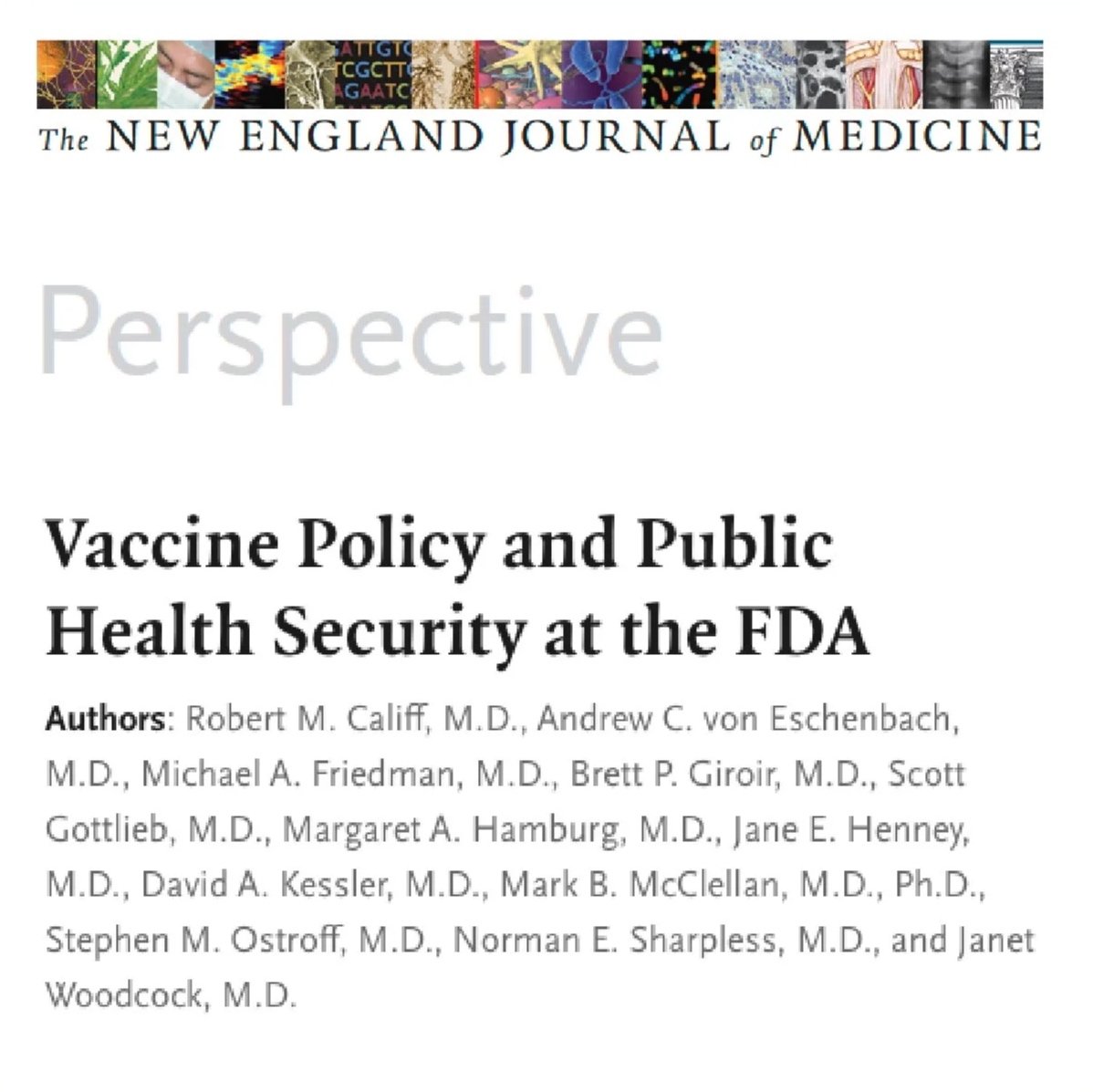
To read the full NEJM article, please click here.
To join us in signing this statement, click here.
“We are confident that the entire biopharma ecosystem of investors, researchers, innovators, patients, and payers will stand behind the former commissioners’ call for an FDA culture rooted in transparency, scientific rigor, and open debate. The American public deserves a regulatory environment that serves as a tailwind, not a headwind, for American biomedical innovation and the health of the nation.
While we are appealing to you to reconsider the proposals in the November 28 memo, we also believe that Congress must now also exercise its oversight responsibilities to ensure repairs to FDAs current and future capabilities, infrastructure, human resources, and reputation begin as soon as possible. The U.S. needs a modern, efficient, and world-leading regulatory agency to maintain its leadership in the life sciences.”